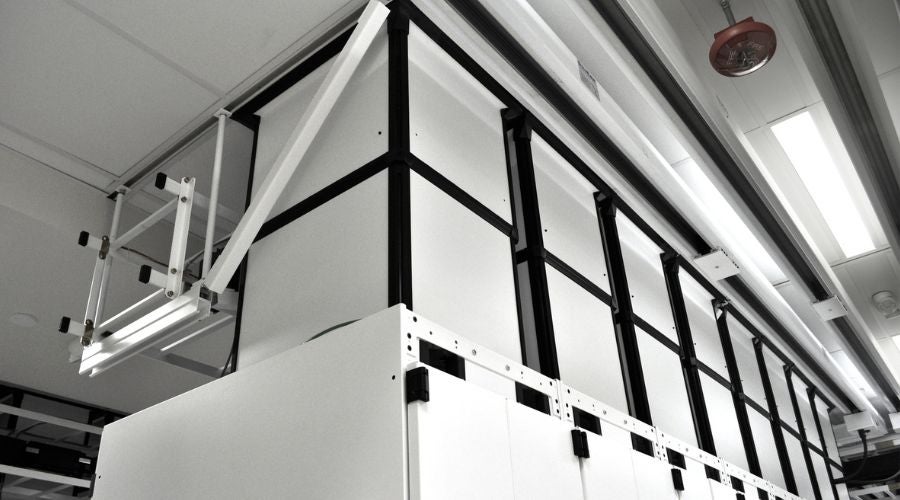
Chatsworth Products (CPI) has long been a leader in data center thermal management solutions, and one of our innovations that we pioneered is the .
The VED, also known as a chimney cabinet, attaches to the top of the cabinet to create a sealed pathway for exhaust air, directing it from the cabinet to an overhead drop ceiling as part of a closed hot air return system. This separation of hot and cold air is critical for optimizing cooling efficiency.
By ensuring proper thermal management, CPI's VEDs help data centers operate at peak performance, even in high-density environments.

The Importance of VED Height in Heat Evacuation
A data center professional recently reached out to Ian Seaton, Chatsworth Products’ (CPI) Global Technology Manager, with a question about determining the best vertical exhaust duct (VED) height in their new raised-floor data center.
Specifically, they wanted to know if there is an ideal VED height for heat evacuation, given that their system will use hot/cold aisle containment and include cabinets with vertical exhaust ducts.
The question was:
"We are currently in the design phase of our new data center, where we plan to use a raised floor for air distribution and cabinets with vertical exhaust ducts (VEDs) for hot/cold aisle separation. I need to determine the correct elevations for the ladder rack and power-distribution bus above the cabinets. I understand that the VED comes in two basic sizes, both with adjustable low and high heights, but I’m wondering if there is an optimal height or ratio that performs better for heat evacuation in the system?"
According to Seaton, while the technical equation suggests that shorter VEDs are more efficient, in practice, there is a lot of flexibility.
As Seaton explained, "Theoretically, if we look at the terms in the Darcy-Weisbach equation for calculating pressure drop or head pressure on a duct, the shorter the VED the better. However, in practical terms, there is no way you can cram enough load into a cabinet to challenge any thresholds within the limits of the standard product offering."
Balancing Space and Efficiency
Rather than focusing on optimizing airflow through the VED, Seaton stresses the importance of balancing space. The key is to maximize the volume of space above the suspended ceiling to allow efficient return air while giving you room for infrastructure such as cable pathways, fiber troughs, and power busways.
Seaton emphasized, "Therefore, you need to find that perfect balance for your own application environment that gives you the maximum volume of space for return air above the suspended ceiling, while giving you adequate room to deploy and manage whatever you plan to put between the cabinet and the ceiling – cable pathway, fiber troughs, power busway."
The Impact of Space Above the VED
Ultimately, the space above the VED should be as short as possible, while still providing enough clearance for the other elements you need to deploy. Seaton explains that the real driver for VED height decisions is not simply maximizing airflow but optimizing the space above it.
"If the space above the ceiling is already disproportionately large, then you have the luxury of basing your decision on access and aesthetics," Seaton added.
Seaton’s advice emphasizes a critical point: While shorter VEDs may seem like the best option for heat evacuation, the true key to efficiency lies in maximizing the available space above the VED. By optimizing this space, you can ensure proper airflow, effective thermal management, and the necessary room for all your infrastructure, keeping your data center running smoothly and efficiently.
Optimizing Your Data Center for Maximum Efficiency
Explore CPI’s and other to enhance the performance and longevity of your data center infrastructure today.