
Introduced in 2003, Power over Ethernet (PoE) revolutionized how devices receive power by delivering it through the network connection. This eliminates the need for separate power connections and simplifies installations.
Currently, PoE can deliver up to 25.5 Watts of power to devices such as: Voice over Internet Protocol (VoIP) desk phones, wireless access points (WAPs) and basic security cameras.
Enhanced PoE Standards for More Power
The enhanced PoE draft amendment, IEEE 802.3bt-2018, proposes two additional types or power ranges, for 60 Watts and up to 100 Watts per connection, thus extending the possibilities to power other end-devices, such as high bandwidth WAPs, pan-tilt-zoom security cameras, access control systems and IoT sensors.
The table below lists some of the technical differences for the various network power standard amendments. Note that each progressive amendment introduces more power to the end-device.
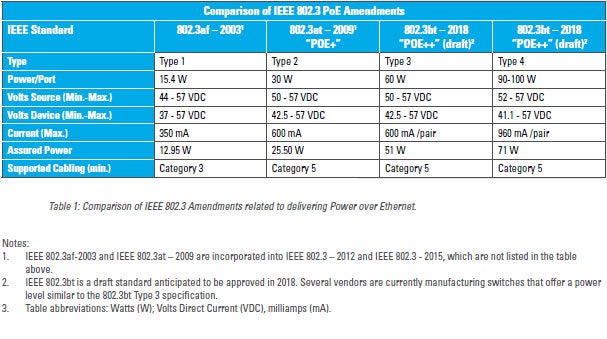
Preparing Your Network for PoE Upgrades
Deploying PoE requires a network switch or a separate in-line power injector to introduce power into the network connection. Network switches that support Type 1 and Type 2 PoE may need to be upgraded to support higher power Type 3 and Type 4 PoE. The power supply in PoE switches is much higher wattage than power supplies for switches that do not support PoE, and consequently, the power connection to the switch is higher power.
Additionally, when PoE powers VoIP phones, a uninterruptable power supply (UPS) and battery backup are typically installed in line with the switch to maintain phone circuits during power outages. Higher power PoE will require a higher capacity UPS and batteries to maintain the same runtime. The switch, UPS and battery backup will also weigh more as compared to a non-PoE switch, which means the rack selected to support the IT equipment needs to be able to handle the additional weight.
Impact on Cabling and Bundling
PoE operates over existing Category 5e Unshielded Twisted Pair (UTP) cabling, but higher power levels (Type 4) generate more heat. This necessitates adjustments in cabling practices:
PoE applications are covered in Article 725 of the 2017 National Electric Code (NEC). Table 725.144 of the NEC provides guidance for bundle size based on the size of the conductor and temperature rating of the cable. For example, for an ambient air temperature of 86° Fahrenheit (30° Celsius), Category 5e UTP cable constructed of 24 American Wire Gauge (AWG) conductors and rated for 60°C would be limited to bundle sizes of 38 to 61 cables.
So, a bundle of 48 cables from a typical 2U patch panel would not need to be modified, but a larger bundle of 72 cables or 96 cables would need to be broken into smaller bundles. This means you may also need to space bundles in cable managers and pathways to maintain better airflow around bundles to remove heat.
Learn More About PoE and Network Best Practices
Stay ahead of the curve with a deeper understanding of technologies shaping enterprise networks. Download our for insights and best practices to support PoE deployments.
