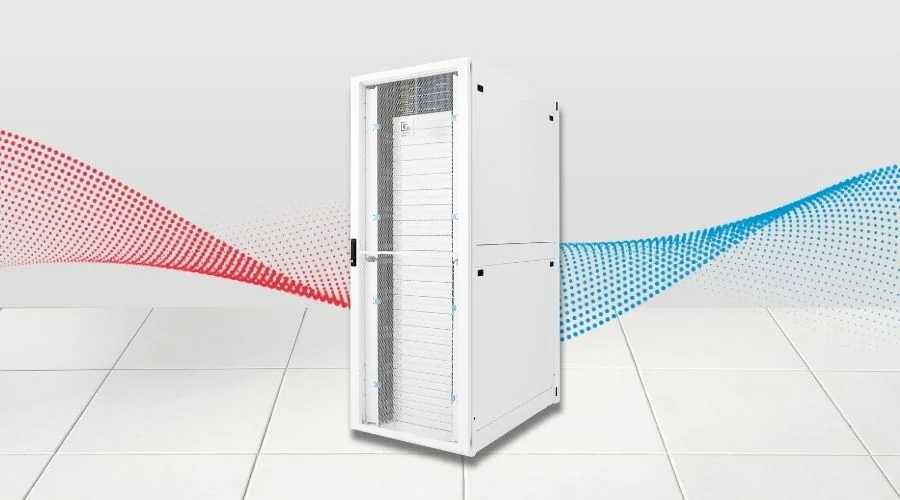
Artificial intelligence (AI), machine learning, and other high-performance computing workloads are reshaping the modern data center. These technologies bring immense processing power, but they also bring a surge in heat. As cabinet densities rise to levels once considered impractical, it’s no longer enough to think about cooling only at the room or facility level. The cabinet itself has become a critical component in the cooling equation.
The Shift to Higher Cabinet Densities
Traditional enterprise data centers were often designed for 5–10 kW per rack. Today, AI workloads are pushing that boundary dramatically higher, with cabinets commonly drawing 30–50 kW and, in some cases, even more. At these levels, small inefficiencies at the cabinet scale translate into significant performance and reliability risks.
When hot exhaust air mixes with cold intake air, the results can be immediate: unstable temperatures, higher fan speeds, and increased energy use. Multiply that across hundreds of racks, and the impact becomes unsustainable. That’s why cabinet-level design and cooling practices are no longer optional—they’re essential.
How to Optimize Air Cooling at the Rack
Air cooling remains a viable and widely used method, but its effectiveness hinges on careful cabinet-level management. Several best practices stand out:
- Seal the cabinet: Use blanking panels for unused rack units, close off gaps, and apply air dams to ensure conditioned air flows only through the equipment.
- Manage cables effectively: Poorly routed cables create airflow blockages and trap hot spots inside the rack.
- Contain airflow: Full hot-aisle or cold-aisle containment—or vertical exhaust duct systems—help ensure exhaust air is isolated from intake air.
When executed properly, these measures can extend the life of air cooling, enabling higher supply air temperatures and reducing the need for over-provisioned cooling capacity.
When Liquid Cooling Becomes Necessary
Even with excellent airflow management, there comes a point where air simply cannot move enough heat out of a cabinet fast enough.
This tipping point often occurs in AI and accelerated computing environments, where processor socket powers are extremely high and cabinets routinely exceed 30–40 kW. At these densities, operators begin to see rising supply air temperatures, unstable thermal zones, and escalating cooling costs—signals that air cooling alone is no longer sufficient.
Liquid cooling at the cabinet level offers a more efficient way to handle extreme loads. Because liquids conduct heat far more effectively than air, these systems can remove large amounts of heat in a smaller footprint and closer to the source.
Two main approaches stand out:
Rear-Door Heat Exchangers (RDHx)
These replace or augment the back door of the cabinet with a liquid-cooled coil. As exhaust air leaves the cabinet, the coil extracts the heat before it reaches the room. This design reduces the thermal burden on facility-level cooling systems and can often be retrofitted onto existing cabinets. Operators must, however, plan for plumbing connections, condensate management, and structural support to ensure safe and reliable operation.
Direct-to-Chip Liquid Cooling
This method uses cold plates or dielectric fluid loops to carry heat away directly from processors and GPUs, the hottest components. This approach unlocks much higher cabinet densities while maintaining stable temperatures.
At these levels, the cabinet itself becomes a critical enabler. Supporting direct-to-chip cooling requires racks engineered to support manifold connections, leak prevention measures, and additional design features that ensure safety and serviceability.
The Hybrid Reality
In practice, liquid cooling doesn’t usually eliminate the need for air. Instead, it complements air cooling in a hybrid approach. Fans still move air through the cabinet to cool lower-power devices and ancillary equipment, while liquid systems target the most demanding components. This balance allows operators to scale workloads without wholesale redesign of the data hall.
The decision to implement liquid cooling is often driven not only by density but also by sustainability and cost. By removing heat more efficiently, liquid systems can lower energy use, enable higher inlet temperatures, and reduce reliance on over-sized CRAC/CRAH units. For many organizations, these gains make liquid adoption at the cabinet level both a performance necessity and a strategic investment.
Reliability and Performance Depend on the Cabinet
Excessive heat doesn’t just drive-up energy costs—it compromises hardware performance and lifespan. Components that run outside recommended temperature ranges may throttle performance or fail prematurely.
Because the cabinet is where airflow meets equipment, it’s also where risks become most acute. Poor sealing, blocked airflow, or a failed cooling accessory at the cabinet can quickly escalate into outages or degraded performance.
That makes cabinet-level monitoring—temperature, airflow, humidity, and even door activity—an essential safeguard.
Energy Efficiency and Sustainability Pressures
Cooling can account for 30–40% of a data center’s total energy consumption. As power densities grow, so does the cost of inefficiency. Cabinet-level improvements—such as fully sealed containment, optimized airflow paths, and selective use of liquid cooling—reduce energy waste and make it possible to safely raise supply air temperatures.
This not only lowers operating expenses but also supports broader sustainability goals. With regulatory frameworks and corporate ESG commitments placing new focus on energy reporting and carbon reduction, cabinet-level design choices directly impact compliance and corporate responsibility.
Practical Steps for Operators
Treating the cabinet as a thermal management system involves both design and operational best practices:
- Design for containment from the start: Ensure cabinets are sealed and ready to integrate with aisle containment systems.
- Plan for hybrid cooling: Even if you begin with air, select cabinets that can support rear-door exchangers or direct-to-chip cooling if densities increase.
- Simplify cable management: Avoid airflow obstructions by using accessories and layouts that keep pathways clear.
- Monitor locally: Place sensors inside cabinets to track temperature, humidity, and airflow in real time.
- Build in redundancy: Ensure cooling elements at the rack—whether fans or liquid loops—are resilient to maintenance or failure events.
These steps help ensure that as AI workloads scale, the infrastructure is ready to support them without unnecessary risk or cost.
The Bottom Line
Cooling is no longer just a facility-level concern. The cabinet itself has become a frontline player in maintaining stability, efficiency, and sustainability. As workloads grow denser and more power-hungry, cabinet-level cooling strategies—whether advanced airflow management or liquid integration—are the key to unlocking reliable performance.
The future of high-density computing depends on cabinets that are engineered not just to hold equipment, but to cool it. Treating cooling as a cabinet-level priority ensures that data centers can keep pace with the next generation of digital demand.
that support high-density workloads with integrated airflow management and liquid cooling readiness. Learn more here or .
