Manufacturing has entered an era of localized intelligence. What began as a discussion around the Industrial Internet of Things (IIoT) has evolved into something far more operational—compute, analytics, and control embedded directly alongside production equipment.
This evolution is reshaping how physical network infrastructure is deployed and protected. Traditional IT frameworks were never designed for environments defined by motion, vibration, and continuous change. In these spaces, reliability depends on how effectively operators can engineer resilience into the physical layer itself.
Here’s how leading organizations are overcoming the space, flexibility, and environmental barriers on the factory floor.
1. Moving Beyond “Floor Space” — Toward Intelligent Physical Layouts
In leading facilities, the discussion is no longer about where to put network equipment but how to integrate it into the operational fabric. The emerging best practice is to treat physical layout as a design variable in system resilience—not an afterthought.
Top operators are:
- Mapping network density to production flow, aligning enclosure placement with automation zones and data aggregation points rather than arbitrary IT footprints.
- Leveraging vertical volume, not just overhead clearance—installing modular wall-mount and column-mount enclosures that align with production cells for low-latency access.
- Designing “infrastructure shadows,"where edge equipment physically follows the process line for data immediacy without floor congestion.
This approach converts constrained space into a structured, high-efficiency network layer—essentially creating a micro data center mesh within the facility envelope.
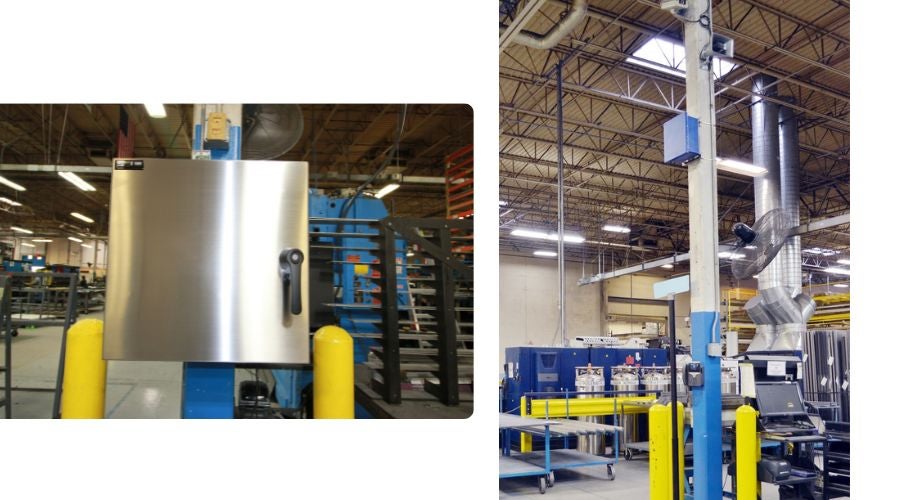
Wall- and column-mounted RMR® Industrial Enclosures preserve floor space while keeping critical network equipment protected and accessible in active production zones.
2. Treating Flexibility as a Lifecycle Metric
Every manufacturing engineer understands that change is constant. But few network designs account for the operational cost of adaptation. Forward-looking teams are building flexibility into the physical layer itself—through zone-based architectures and service modularity.
Instead of rewiring when production lines move, they:
- Define network “zones of influence” with localized switching and power management.
- Use pre-terminated fiber trunks and modular patching blocks that can be re-deployed in hours instead of days.
- Combine power, data, and environmental monitoring in unified enclosures—simplifying integration and accelerating deployment across production zones.
This design philosophy reframes flexibility from a one-time convenience to a continuous operational metric. Infrastructure can now evolve on the same timeline as the production process itself—an essential capability as facilities adopt automation, analytics, and AI at the edge.
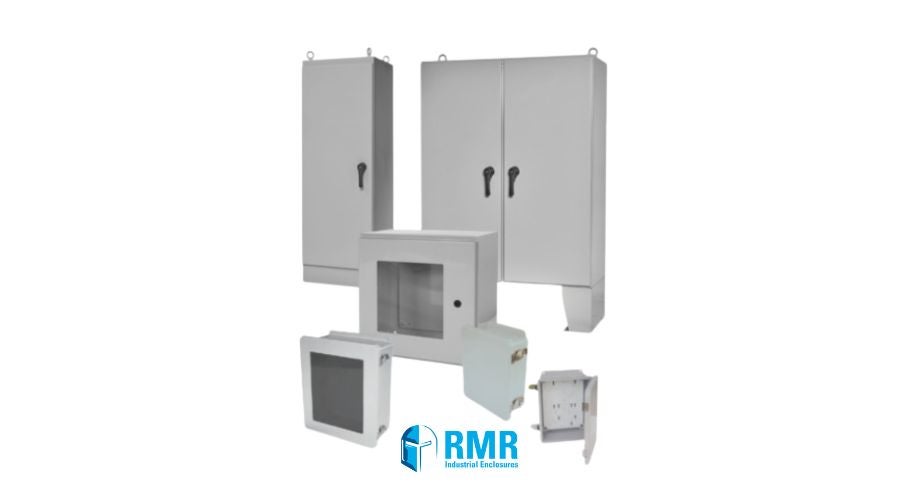
CPI’s broad portfolio of RMR® Industrial Enclosures offers scalable, configurable options for every environment—enabling modular, zone-based network design and long-term flexibility at the edge.
3. Hardening Is No Longer Enough — Environmental Intelligence Is the New Standard
Dust, vibration, and temperature have long been baseline considerations in industrial design. What’s changing is the growing emphasis on real-time environmental visibility at the enclosure level—a shift from passive protection to active, data-informed management of conditions across distributed edge sites.
Modern industrial enclosures now function as edge monitoring nodes, integrating:
- Environmental sensors for temperature, humidity, and air quality that feed directly into building management or DCIM platforms.
- Smart power distribution units (PDUs) with granular circuit telemetry, allowing operators to trend power stability against environmental data.
- Predictive alerts based on historical conditions—identifying thermal or ingress risk before failure occurs.
This shift turns passive protection into active intelligence—essential for distributed facilities where a single technician may oversee dozens of edge enclosures across multiple sites.
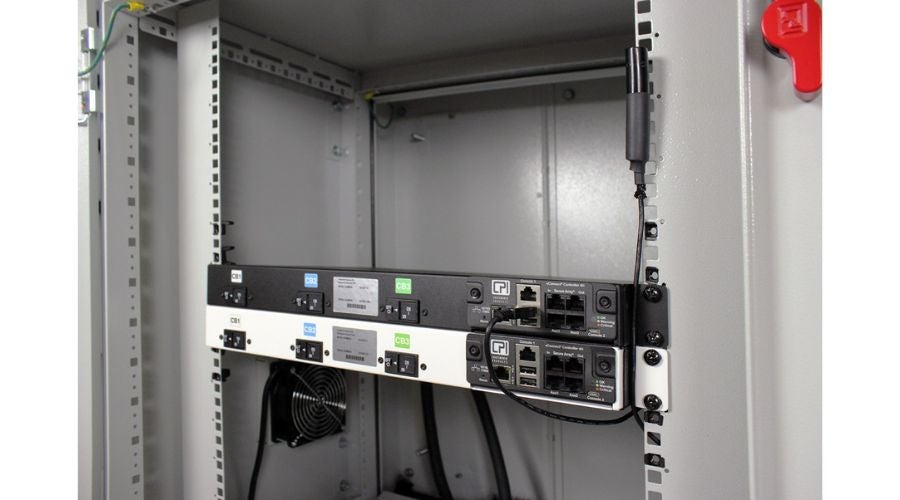
When paired with eConnect® PDUs, RMR cabinets enable integrated environmental sensing and remote power management—delivering visibility and control from day one of deployment.
4. Designing for Edge-Grade Continuity
Another shift is underway in industrial edge infrastructure design—away from basic ruggedization and toward sustained operational continuity. As AI-assisted process control and machine-learning workloads are deployed closer to production systems, any instability in the physical layer now propagates directly into process analytics, automation efficiency, and overall equipment effectiveness.
Modern edge strategies integrate:
- High-availability network architectures distributed across multiple enclosures or production cells to eliminate single points of failure.
- Advanced thermal and power design that sustains equipment performance under variable environmental and computational loads.
- Integrated access control systems that unify physical and network security, ensuring that every point of entry—digital or mechanical—is identity-verified and logged.
These changes mark a fundamental redefinition of industrial reliability—from static protection to dynamic resilience.
Protecting Performance at the Industrial Edge with CPI
The transformation at the manufacturing edge is no longer just about connecting more devices. It’s about designing physical network infrastructure that can sustain intelligent operations at the edge—where uptime, configurability, and environmental resilience are non-negotiable.
CPI’s can be engineered to function as part of a distributed, data-aware ecosystem:
- Environmental awareness at the edge: Integrate temperature and humidity sensors directly into the cabinet for real-time condition monitoring and trend analysis.
- Power and access intelligence: Seamless compatibility with eConnect® PDUs and electronic access systems enables granular visibility, control, and security down to the individual circuit or door event.
- Adaptive thermal design: Select from sealed, filtered, or active cooling options to maintain stable thermal conditions across varied industrial environments.
- Flexible mounting formats (wall, floor, column, or overhead) to match evolving production geometries.
- Certified protection: Meets or exceeds NEMA and IP standards, ensuring long-term reliability even in high-dust, moisture, or vibration-prone environments.
or to discuss a custom solution for your unique requirements.