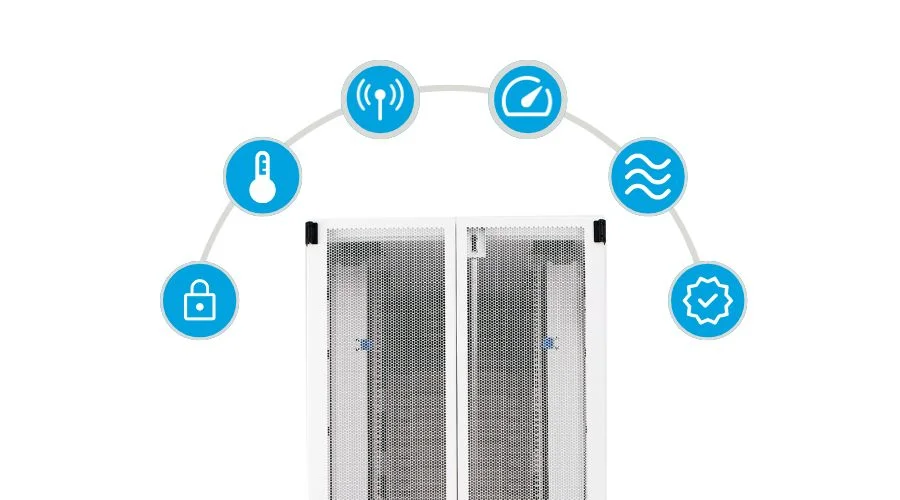
High-density data center cabinets are no longer simple enclosures—they are engineered platforms that must support structural load, control airflow, and enable the integration of power and cooling systems required for AI, HPC, and other compute-intensive workloads.
As rack densities climb beyond traditional thresholds, performance is no longer limited by how much power can be delivered to the rack—but by how effectively the cabinet can support, cool, and sustain that load over time.
What Makes a Cabinet Suitable for High-Density Support
Structural Engineering: The Foundation of High Density
High-density environments introduce significant physical demands that standard cabinets are not designed to handle. Dense GPU configurations, liquid cooling components, and high-capacity power distribution systems all contribute to increased weight and structural stress.
Cabinets designed for high-density deployments must provide:
- High static load capacity to support fully populated racks
- Strong dynamic load ratings to ensure stability during installation and maintenance
- Durable frame construction that maintains integrity across multiple equipment refresh cycles
Without sufficient structural engineering, cabinets can become a limiting factor—restricting deployment options or introducing long-term reliability risks.
Thermal Management: Where High-Density Performance Is Won or Lost
At higher power densities, airflow design—not just cooling capacity—determines whether equipment can operate reliably without throttling.
Effective high-density cabinets are engineered to:
- Eliminate bypass airflow that reduces cooling efficiency
- Maintain clear separation between intake and exhaust air
- Support cabinet-level containment strategies that guide heat out of the rack
Poor airflow design leads to recirculation, hot spots, and unpredictable inlet temperatures—forcing operators to reduce compute density or overcompensate with additional cooling.
In contrast, cabinets with integrated airflow architecture create controlled, repeatable thermal performance that supports higher densities without increasing energy consumption.
Cable Management: A Critical but Overlooked Thermal Function
As rack density increases, so does cable volume. Without proper routing and management, cables can obstruct airflow paths and degrade cooling performance.
High-density cabinet designs must incorporate:
- Dedicated pathways that preserve exhaust and intake airflow
- Separation of power and data cabling to reduce congestion
- Scalable cable management that supports future growth
In high-density environments, cable management is not just about organization—it is a key component of thermal control.
Integrated Power Enablement (Through PDU Architecture)
While cabinets do not define power capacity, they must support the integration of high-density power distribution systems.
This includes:
- Space and mounting provisions for high-capacity PDUs
- Thermal tolerance for elevated operating temperatures
- Cable routing that supports high-power connections without restricting airflow
Modern deployments rely on , flexible outlet configurations, and granular monitoring. Cabinets that are designed for pre-integration simplify deployment and ensure these systems operate reliably within high-density environments.
ZetaFrame® Cabinet System: Engineered for High-Density Integration
The is designed as an integrated platform that aligns structural performance, airflow management, and system-level integration to support high-density deployments.
Engineered for Structural and Thermal Performance
ZetaFrame supports high static and dynamic loads, providing the structural foundation required for dense compute environments and liquid cooling integration.
Its airflow architecture is built into the cabinet design, creating defined intake and exhaust pathways that minimize bypass air and maintain consistent inlet temperatures.
By leveraging principles such as pressure differentials and airflow acceleration, the cabinet helps remove heat efficiently without relying solely on additional mechanical cooling.
Pre-Integrated Power for Deployment Efficiency
ZetaFrame enables factory integration of eConnect PDUs, allowing power distribution, monitoring, and physical infrastructure to function as a single validated system.
This approach:
- Reduces field installation complexity
- Ensures compatibility between cabinet, power, and airflow systems
- Improves deployment speed and repeatability across environments
Rather than treating power as a separate layer, pre-integration aligns it with the cabinet’s thermal and structural design.
Designed for Hybrid and Liquid Cooling Strategies
ZetaFrame is built to support , rear-door heat exchangers, and hybrid cooling approaches without requiring field modifications.
By enabling liquid cooling to remove heat directly at the source—while the cabinet manages remaining airflow—operators can:
- Increase rack density beyond air-only limits
- Maintain stable inlet temperatures
- Reduce overall cooling energy requirements
This integrated approach allows for incremental adoption of liquid cooling without disrupting existing infrastructure.
Key Specifications to Evaluate
Load Capacity and Structural Integrity
Cabinets should provide sufficient static and dynamic load capacity with additional margin to support fully configured racks and future upgrades. Structural design must also account for long-term durability and, where applicable, seismic considerations.
Airflow Design and Thermal Architecture
Airflow performance should be a primary evaluation criterion. Look for cabinets that:
- Eliminate bypass and recirculation
- Maintain clear intake and exhaust separation
- Support containment and predictable airflow patterns
Thermal performance at the cabinet level directly impacts achievable rack density.
Cable Management and Internal Layout
Internal layout should preserve airflow while supporting increasing cable volumes. Effective designs enable clean routing, reduce congestion, and maintain serviceability as density grows.
Integration Capabilities
High-density cabinets must support the integration of power distribution and cooling systems, including:
- Intelligent PDUs
- Liquid cooling infrastructure
- Environmental monitoring systems
Factory integration can further improve deployment consistency and reduce field risk.
Power Delivery (Enabled Through PDUs)
Power capacity is delivered through integrated PDUs, but the cabinet must support their physical and thermal requirements.
Considerations include:
- Compatibility with high-capacity PDUs
- Temperature tolerance for high-density environments
- Monitoring capabilities for capacity planning and load management
Planning for High-Density Deployment
Facility Readiness
High-density cabinets must align with facility capabilities, including:
- Electrical infrastructure to support increased loads
- Cooling systems capable of handling localized heat concentrations
- Floor loading capacity for heavier equipment configurations
System Integration and Operational Readiness
Successful deployments depend on how well cabinet infrastructure integrates with existing systems.
Pre-integrated solutions can:
- Reduce deployment time
- Minimize configuration errors
- Simplify ongoing management
Training and operational processes should also evolve to support advanced cooling and monitoring technologies.
Rethinking the Role of the Cabinet
As data centers evolve to support , the cabinet is no longer just a passive enclosure. It is a critical part of the thermal and structural system that determines how much compute can be deployed—and how efficiently it can operate.
Organizations that prioritize cabinet-level engineering—structural integrity, airflow design, and integrated system support—will be better positioned to scale density, improve efficiency, and reduce deployment risk as infrastructure demands continue to grow.