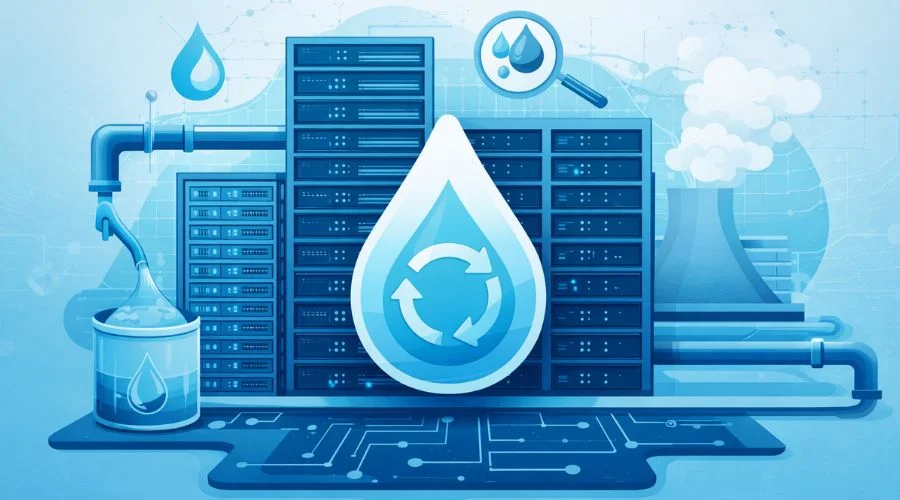
Water is quickly becoming one of the most scrutinized resources in data center operations. As sustainability targets tighten and regional water constraints intensify, operators are taking a closer look at how their cooling strategies impact both environmental performance and long-term scalability.
At the same time, rising rack densities—driven by AI and HPC workloads—are increasing the demand for heat rejection. Many facilities have responded by expanding their use of evaporative cooling or chilled-water systems. While effective, these approaches can significantly increase water consumption, creating a new operational challenge.
The reality is that most operators cannot simply replace existing cooling infrastructure. Instead, the industry is shifting toward hybrid cooling strategies—combining air-based systems with targeted liquid or rear-door solutions. But the success of that approach depends on something often overlooked: how efficiently air is managed at the cabinet level.
Why Cooling Inefficiency Drives Water Usage
In many environments, cooling inefficiency—not just compute demand—is a major contributor to water use. Air bypass, recirculation, and inconsistent inlet temperatures mean that cooling systems must work harder than necessary to maintain safe operating conditions.
When airflow is not controlled, water-based systems are forced to run more frequently and at higher capacity. This increases both energy and water consumption, even when IT loads remain constant.
Reducing that inefficiency is one of the most immediate ways to lower water usage without overhauling facility infrastructure.
What Hybrid Cooling Looks Like in Practice
Hybrid cooling does not mean abandoning air cooling. Instead, it focuses on applying the right cooling method to the right workload.
Most deployments follow a practical model:
- Air cooling remains the baseline for standard-density environments
- High-density zones are supported with targeted solutions, such as rear-door heat exchangers or direct-to-chip liquid cooling
This approach allows operators to manage increasing densities while limiting the expansion of water-intensive systems. However, for hybrid strategies to be effective, airflow must be predictable and controlled—starting at the cabinet.
The Cabinet-Level Opportunity
A significant portion of cooling loss occurs before air ever reaches the IT equipment. Hot and cold air mixing, leakage through unsealed spaces, and inconsistent cabinet design all contribute to thermal inefficiency.
Addressing these issues at the cabinet level can materially reduce cooling demand, which in turn reduces reliance on water-based systems.
Operators can take several practical steps:
Implement airflow containment.
Separating hot and cold air streams eliminates mixing and improves cooling efficiency. Containment also enables higher return air temperatures, reducing the load on upstream cooling systems.
Standardize on cabinets designed for predictable airflow.
Cabinet design plays a critical role in thermal performance. Cabinet systems like CPI’s ZetaFrame® are engineered to support consistent front-to-rear airflow, helping maintain stable inlet temperatures even in high-density environments.
Seal and optimize the cabinet interior.
Blanking panels, brush grommets, and effective cable management reduce bypass airflow and prevent recirculation. This ensures that conditioned air reaches active equipment instead of being lost.
Enable selective densification.
Not every rack requires liquid cooling. By identifying high-density applications and applying targeted solutions—such as rear-door heat exchangers—operators can limit water usage to where it is truly needed.
Improve thermal visibility.
Environmental monitoring allows operators to identify inefficiencies and avoid overcooling. More precise control reduces unnecessary runtime for water-intensive systems.
Lower Cooling Demand, Lower Water Use
These cabinet-level improvements have a compounding effect. By reducing thermal waste, operators lower the total cooling demand within the space. As a result, evaporative and chilled-water systems can operate less frequently and at lower capacity.
The outcome is a measurable reduction in water consumption—achieved without major infrastructure changes.
Supporting a More Sustainable Cooling Strategy
As data centers continue to scale, water usage will remain a critical consideration alongside power and space. Hybrid cooling provides a flexible path forward, but it is most effective when supported by efficient airflow management.
Chatsworth Products (CPI) helps enable this approach through integrated infrastructure solutions. Airflow containment solutions, including the Elevate™ Adjustable Containment Solution, reduce hot and cold air mixing and improve thermal performance. The supports predictable airflow in high-density deployments, while cabinet-level accessories help seal and optimize the environment to reduce thermal loss.
Water conservation in data centers does not start with replacing cooling systems—it starts with reducing how hard they need to work. By optimizing airflow at the cabinet level, operators can take a meaningful step toward more efficient, scalable, and sustainable operations.
Reduce cooling demand without overhauling your infrastructure.
Explore how and cabinet solutions can help you improve efficiency and lower water usage.