
To implement hybrid cooling in a data center, operators must combine optimized airflow with targeted liquid cooling at the cabinet level, applying each method based on workload density and thermal demand.
This approach allows higher rack densities without requiring a full facility redesign, while maintaining flexibility as workloads evolve.
Step 1: Assess Your Current Thermal and Power Conditions
Before introducing hybrid cooling, start with a clear understanding of your existing environment.
Focus on:
- Current rack power densities (average vs. peak)
- Airflow performance and temperature variation across rows
- Available cooling capacity at the room and row level
- Power delivery constraints and variability
In many environments, the issue isn’t total cooling capacity—it’s how effectively that cooling is delivered. Identifying hotspots, airflow inefficiencies, and uneven density distribution is critical before adding new cooling methods.
Step 2: Segment Workloads by Density and Risk
Hybrid cooling works best when it’s applied selectively—not uniformly.
Segment your environment into:
- Low-density racks (traditional IT loads)
- Moderate-density racks (growing compute demand)
- High-density racks (AI, GPU, HPC workloads)
This segmentation allows you to:
- Maintain air cooling where it remains effective
- Introduce liquid cooling only where necessary
- Avoid overbuilding infrastructure across the entire facility
This is where many implementations fail—treating hybrid cooling as a blanket solution rather than a targeted strategy.
Step 3: Choose Your Hybrid Cooling Approach
Once workloads are segmented, the next decision is how hybrid cooling will be applied. In practice, most implementations follow one of two models: cabinet-level integration or facility-level (pod-based) deployment.
The right approach depends on density targets, facility constraints, and how much control is needed at the rack level.

Path 1: Cabinet-Level Hybrid Cooling
Cabinet-level hybrid cooling integrates liquid cooling directly within the cabinet to remove high-intensity heat at the source, while airflow manages the remaining thermal load.
Where it fits
- 20 kW–40 kW+ racks (and climbing)
- Enterprise and colocation environments
- Incremental AI deployment within existing data centers
How It Works
- Direct-to-chip liquid cooling removes the primary heat load from CPUs/GPUs
- Airflow continues to manage residual heat from components like memory, storage, and power supplies
- Both systems operate simultaneously within the same enclosure
Why It’s Effective
- Reduces reliance on high airflow volumes
- Stabilizes inlet temperatures at higher densities
- Allows targeted deployment without redesigning the entire facility
What the Physical Setup Looks Like
- Liquid distribution via CDU and manifold systems
- Tubing routed cleanly within or adjacent to the cabinet
- Structured cable management to preserve airflow pathways
- Space and load capacity to support cooling hardware
Cabinets designed for hybrid cooling must support both airflow integrity and liquid integration—without introducing additional fans or disrupting thermal balance.
In practice, cabinet-level hybrid strategies have demonstrated measurable efficiency gains in high-density environments, particularly when liquid cooling is used to offload processor heat while airflow maintains overall thermal stability.
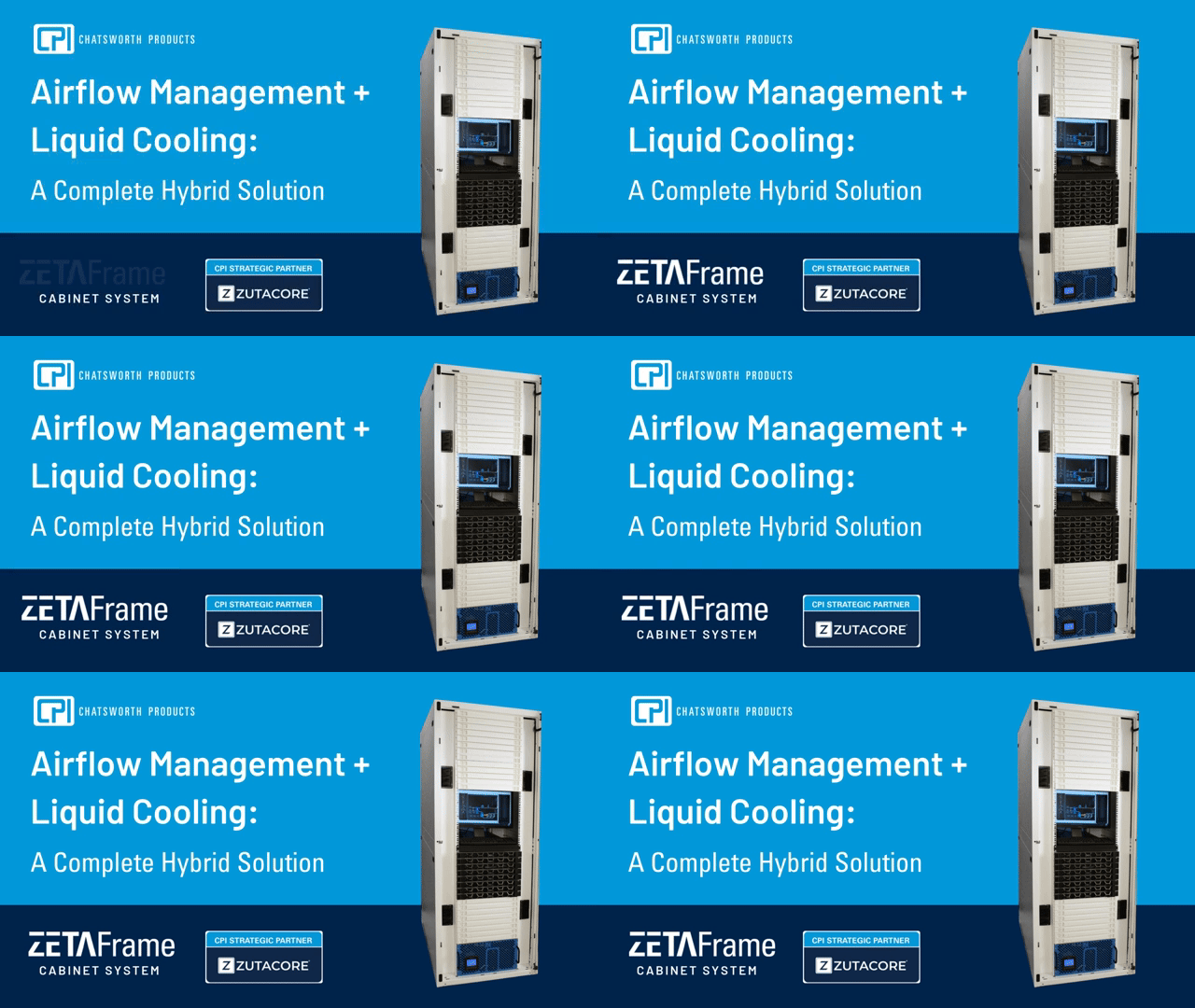
Hybrid cooling at the cabinet level is easier to understand when you can see how airflow and liquid cooling systems operate together within a real environment.
The video below provides a practical example of how hybrid cooling is implemented at the cabinet level, including how heat is removed at the source while airflow manages the remaining thermal load.
Path 2: Facility- or Pod-Level Hybrid Cooling
In this model, liquid cooling is deployed across a group of cabinets—typically within a dedicated AI or high-density pod—while the rest of the data center remains air-cooled.
Where it fits
- Hyperscale or large enterprise AI deployments
- New builds or pre-engineered environments
- Standardized high-density zones
Key Requirements for Success
- Consistency across cabinets is critical
- Inlet temperatures must be uniform
- Airflow behavior must be predictable
- Liquid cooling circuits must perform consistently
- Thermal performance cannot vary cabinet-to-cabinet
- Unlike cabinet-level approaches, variability introduces risk
- Infrastructure must be standardized
- Same cabinet design
- Same airflow characteristics
- Same power and cooling integration
Pod-level hybrid cooling depends on system-wide predictability. If airflow or cooling performance varies across cabinets, it can create instability across the entire pod.
What Both Hybrid Cooling Approaches Require
Regardless of implementation model, hybrid cooling depends on alignment between:
- Airflow management
- Liquid cooling integration
- Power delivery
- Environmental monitoring
Whether implemented at the cabinet or pod level, hybrid cooling is most effective when these systems are engineered together—not added independently.
Read also: Why Hybrid Cooling Is Becoming the Default Data Center Strategy.
Common Implementation Challenges (and How to Avoid Them)
Even well-planned hybrid cooling strategies can fall short if key issues are overlooked.
- Over-reliance on Facility-Level Cooling: If cabinet airflow isn’t optimized first, adding liquid cooling won’t solve underlying inefficiencies.
- Poor Airflow Management Inside the Cabinet: Cable congestion, poor layout, and lack of containment can disrupt airflow and reduce overall effectiveness.
- Treating All Racks the Same: Not every rack needs liquid cooling. Over-applying it increases complexity without delivering proportional value.
- Lack of Monitoring and Visibility: Without real-time insight into thermal conditions, it’s difficult to manage hybrid environments effectively.
- Where Infrastructure Design Makes the Difference: Hybrid cooling success is heavily influenced by how well the physical infrastructure supports both airflow and liquid integration.
This includes:
- Cabinets designed for high-density and hybrid configurations
- Airflow management features that maintain consistent thermal performance
- Structural capacity to support additional cooling hardware
- Integrated pathways for power, cabling, and monitoring
When these elements are engineered as part of a system—not added later—hybrid cooling becomes significantly more predictable and scalable.
Designing for Hybrid Cooling Starts with the Right Infrastructure
Hybrid cooling success depends on how well airflow, power, and cooling systems are integrated at the cabinet level.
Chatsworth Products (CPI) supports both cabinet-level and pod-level hybrid cooling strategies through infrastructure designed for high-density performance, airflow control, and liquid cooling integration.
Explore how CPI solutions support hybrid cooling deployments or connect with a CPI expert.
