
Hybrid Cooling is a data center cooling strategy that combines air and liquid cooling to manage different types of heat loads more efficiently.
In practice, this can take two forms: introducing liquid cooling at the facility or pod level for specific workloads or integrating liquid cooling within individual cabinets to handle concentrated heat while airflow manages the remaining thermal load. Both approaches aim to support higher densities without requiring a full facility redesign.
Why Traditional Cooling Models Are Breaking Down
For years, cooling decisions were framed as a binary choice:
- Continue scaling with air cooling
- Or transition entirely to liquid cooling
That model worked when workloads were relatively predictable and rack densities increased gradually. Today, that’s no longer the case.
AI and high-performance computing (HPC) workloads introduce new thermal dynamics:
- Rapid and unpredictable power fluctuations
- Concentrated heat at the component level
- Rack densities that can exceed traditional airflow capacity
Air cooling alone becomes inefficient as densities climb, requiring higher fan speeds, tighter environmental controls, and more energy. On the other end of the spectrum, full liquid cooling often demands significant infrastructure changes, new operational expertise, and higher upfront investment.
Hybrid cooling addresses this gap by enabling a more balanced, incremental approach.
What Hybrid Cooling Actually Means
Hybrid cooling is often misunderstood as simply “using air and liquid in the same space.”
In practice, it’s a coordinated thermal strategy where each method is applied intentionally based on heat load and system requirements.
In a hybrid cooling environment:
- Air cooling continues to manage ambient and lower-density heat loads
- Liquid cooling targets high-intensity heat directly at the component level (such as CPUs and GPUs)
- Both systems operate simultaneously, reducing the burden on either one alone
This division of responsibility leads to:
- Improved thermal efficiency
- More stable inlet temperatures at the rack level
- Reduced strain on facility-level cooling systems
Rather than replacing air, hybrid cooling extends its effectiveness.
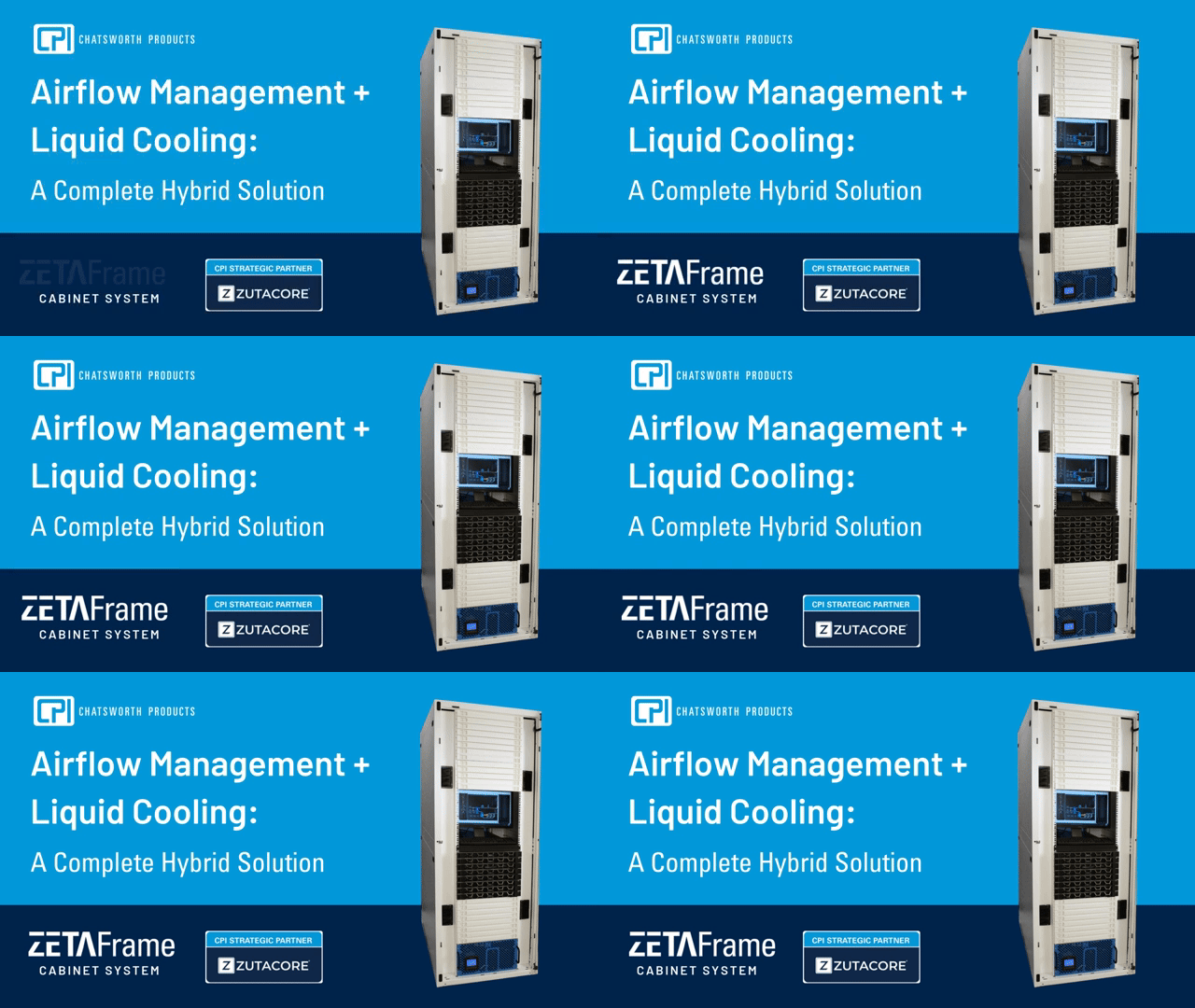
Hybrid cooling is easier to understand when you can see how airflow and liquid cooling work together within a cabinet environment.
The video below provides a practical example of how hybrid cooling strategies are applied to support higher-density workloads without relying on a full facility redesign.
Two Ways Hybrid Cooling Is Implemented
Hybrid cooling is used to describe two distinct—but related—approaches in modern data centers.
1. Facility- or Pod-Level Hybrid Cooling
In this model, liquid cooling is deployed in specific zones, pods, or clusters designed for high-density workloads such as AI or HPC.
- The broader data center remains air-cooled
- Liquid is introduced only where densities exceed airflow limits
- Often used in new builds or pre-engineered AI deployments
This approach allows operators to scale high-density capacity without redesigning the entire facility.
2. Cabinet-Level Hybrid Cooling
In this model, liquid cooling is integrated directly within the cabinet to remove heat from high-power components, while airflow continues to manage residual heat within the same enclosure.
- Air and liquid operate simultaneously at the cabinet level
- Enables targeted densification within existing environments
- Common in colocation and enterprise deployments
This approach provides more granular control over thermal performance and allows hybrid cooling to be deployed incrementally.
Why Both Models Matter
Both approaches solve the same core problem—managing increasing heat density—but they differ in how and where cooling is applied.
As data center designs evolve, many environments use a combination of both strategies, depending on workload requirements and deployment constraints.
Infrastructure that supports hybrid cooling must be flexible enough to operate across both models—whether enabling cabinet-level liquid integration or supporting higher-density deployments within larger liquid-cooled environments.
Where Hybrid Cooling Delivers the Most Value
Hybrid cooling is particularly effective in environments facing uneven or evolving thermal demands.
1. Mixed-Density Environments
Most data centers don’t operate at a single density. Some racks may remain relatively low power, while others—especially those supporting AI—require significantly more cooling capacity. Hybrid strategies allow operators to apply liquid cooling only where it’s needed.
2. Existing Facilities Adapting to AI
Many organizations are not building new data centers from scratch—they’re adapting existing environments. Hybrid cooling makes it possible to support higher-density workloads without redesigning the entire facility or overhauling existing HVAC systems.
3. Phased or Incremental Deployment Strategies
Hybrid cooling supports gradual adoption. Operators can introduce liquid cooling at the rack or cabinet level and expand over time as density requirements increase, avoiding large, disruptive transitions.
The Shift: From Facility-Level to Cabinet-Level Thinking
While hybrid cooling can be implemented at the facility or pod level, many organizations are increasingly shifting toward cabinet-level control to improve precision and flexibility.
One of the most important changes behind hybrid cooling adoption is a shift in where cooling decisions are made.
Traditionally, cooling was designed at the room or facility level, with the assumption that airflow could be distributed evenly across all racks. That assumption breaks down in high-density environments, where heat generation is localized and highly variable.
Hybrid cooling aligns with a cabinet-level approach, where thermal performance is managed closer to the source of heat.
This enables:
- Targeted deployment of liquid cooling within specific racks
- More precise airflow management through the cabinet
- Better isolation of high-density workloads
By focusing on the cabinet as the primary control point, operators gain more flexibility and predictability in how cooling is applied.
Read also: Why Hybrid Cooling Is Becoming the Default Data Center Strategy.
Why Hybrid Cooling Is Becoming the Default Strategy
Hybrid cooling adoption is accelerating because it aligns with how modern data centers are evolving.
It allows operators to:
- Increase rack density without immediately upgrading facility-wide cooling systems
- Support AI and GPU workloads within existing infrastructure constraints
- Balance performance, cost, and operational risk
Just as importantly, hybrid cooling supports selective densification—scaling cooling capacity only where required instead of overbuilding for peak conditions across the entire data center.
This makes it a more efficient and adaptable long-term strategy.
What Hybrid Cooling Requires to Work
Hybrid cooling is not simply a matter of adding liquid cooling technology. Its effectiveness depends on how well the supporting infrastructure is designed.
Key requirements include:
- Airflow management at the cabinet level to maintain consistent inlet temperatures
- Mechanical capacity to support additional cooling components, such as heat exchangers or liquid distribution hardware
- Structured cable management to prevent airflow obstruction in high-density environments
- Integrated power and monitoring systems to manage dynamic loads and environmental conditions
Without these elements, hybrid cooling systems may struggle to deliver the expected performance gains.
Common Misconceptions About Hybrid Cooling
As adoption increases, several misconceptions continue to shape how hybrid cooling is evaluated:
- “It’s a temporary solution.” Hybrid cooling is becoming a long-term strategy for many environments, not just a transitional phase.
- “It adds unnecessary complexity.” When implemented at the cabinet level, hybrid cooling can simplify deployment by avoiding large-scale facility changes.
- “It requires full liquid readiness across the data center.” Hybrid strategies are designed specifically to avoid that requirement, enabling targeted implementation.
Understanding these distinctions is critical to making informed design decisions.
How to Apply Hybrid Cooling in Data Centers
Hybrid cooling is not a one-size-fits-all approach. It depends on workload mix, rack density, and facility constraints, with some environments using liquid cooling at the cabinet level and others applying it within high-density zones.
To see how these concepts are applied in real environments, read How to Implement Hybrid Cooling in a Data Center or see how Chatsworth Products combines liquid and air cooling within a single cabinet for high-density environments.
