As organizations rapidly expand distributed networks, branch connectivity, and edge application processing, one shift has gone largely unaddressed: today’s edge sites are generating more heat than ever, while still being supported by environments never intended to manage thermal load.
Unlike traditional data centers—purpose-built for controlled airflow—remote edge locations often operate at ambient room temperature, without ventilation strategies, airflow planning, or proactive thermal oversight.
This growing mismatch between workload density and physical infrastructure readiness has turned cooling into a real deployment risk. Edge success is no longer only about getting equipment connected and powered—it depends on whether the surrounding infrastructure enables safe, consistent, and predictable heat dissipation over time.
How Edge Conditions Amplify Cooling Difficulties
In a data center, heat is managed by engineering. There are defined intake and exhaust paths, controllable environmental settings, and an architecture designed around airflow directionality and temperature containment.
At the edge, nearly all that falls away. Instead, edge installations often face:
- Ambient rooms without directional airflow: Heat accumulates vertically and remains trapped.
- Lack of segregation between intake and exhaust: Warm air recycles directly into IT equipment.
- Tight, shallow mounting environments: Reduced clearance often traps heat behind equipment.
- Limited or nonexistent ventilation policies: Doors, panels, and walls can act as heat sinks.
- Cable congestion blocking exhaust paths: Cable bundles can unintentionally suffocate airflow channels.
And unlike centralized locations staffed with IT teams, edge sites are typically “install and forget” environments. Maintenance cycles are less frequent, airflow is rarely monitored, and temperature rise is often only discovered after an outage.
How Heat Failure at the Edge Happens and Its Real Business Impact
Edge computing is no longer a “small device in a closet” scenario.
Today’s distributed deployments may include a dense mix of power- and heat-generating equipment, such as:
- Layer-3 switches with high PoE draw
- Compact storage units or micro-edge appliances
- UPS systems
- Security gateways and firewall appliances
- Networking gear supporting multiple wireless zones
- I/O modules for automation and IoT telemetry
When these systems are deployed without airflow awareness, several common mistakes accelerate thermal failure, including mounting gear flush against walls, overstuffing cables, placing PoE switches where heat naturally pools, or relying on enclosures with decorative—but non-functional—venting.
Over time, thermal stress shows up in measurable and often costly ways. Devices may throttle performance to stay within safe operating limits, fans are forced to run at maximum speeds for extended periods, and electronic components age faster than expected. Optics and power modules—especially in PoE-heavy environments—fail earlier than their projected lifecycle, while unexpected shutdowns or reboots are frequently misdiagnosed as software issues rather than temperature-driven events.
What makes these failures especially difficult to diagnose is the distributed nature of edge infrastructure. A single device failure is often treated as an isolated incident—until the same pattern appears across multiple locations. By then, the root cause has already compounded.
Why Better Airflow Management Is the New Advantage
The edge reality is that most deployments will never receive dedicated cooling. In practice, few organizations are willing or able to run new ductwork, modify HVAC zoning, or install supplemental air conditioning across dozens—or hundreds—of remote sites. Introducing active cooling equipment is rarely the right first step.
What edge environments need instead is airflow-aware physical infrastructure.
A purpose-built enclosure can dramatically improve thermal outcomes by:
- Preserving front-to-rear airflow paths
- Providing sufficient depth clearance around heat-exhausting hardware
- Preventing cable congestion near exhaust zones
- Positioning equipment to support natural convection
- Eliminating thermal “dead zones” inside the enclosure
- Enabling device-level environmental monitoring
In fact, the single biggest driver of improved thermal performance at the edge is not cooling the room—it’s ensuring that heat moves in the direction the equipment was designed for.
When airflow is managed correctly, organizations see tangible benefits: longer device lifecycles, fewer fan replacements, reduced service calls, higher availability during peak usage, and lower operational downtime. And as edge sites increasingly support mission-critical workflows—payment processing, industrial automation, healthcare systems, real-time analytics—stability is no longer optional.
Edge infrastructure has shifted from a supporting role to a primary enabler.
Cooling Starts with the Enclosure: What Modern Edge Sites Require
A modern enclosure designed for thermal performance in constrained environments should deliver more than basic mounting capability.
At minimum, enclosures should offer:
- Passive ventilation aligned with equipment airflow—not just perforation, but directional venting
- Cable management that protects intake and exhaust zones, especially near power-dense switches
- Adequate depth support for devices that exhaust into confined spaces
- Access-controlled doors that maintain airflow while preserving security
- Mounting layouts that prevent heat stacking through proper spacing
Equally important, edge locations should have a path to add environmental monitoring over time. Visibility into temperature trends, threshold alerts, and environmental changes can prevent minor issues from turning into costly service dispatches.
Organizations planning edge deployments must account for how much heat will be generated at each site, where that heat will go once expelled, whether cabling and enclosure depth will interfere with airflow, and how higher-density scenarios will be supported as workloads evolve. Addressing those questions early is critical to long-term reliability.
Organizations evaluating edge deployments should ask these questions:
- How much heat will be generated at this site?
- Where will that heat go once expelled?
- Will cable organization affect airflow?
- Are devices exhausting into confined space?
- Have optional cooling kits for high density applications and environments been deployed?
Addressing those questions early determines long-term reliability.
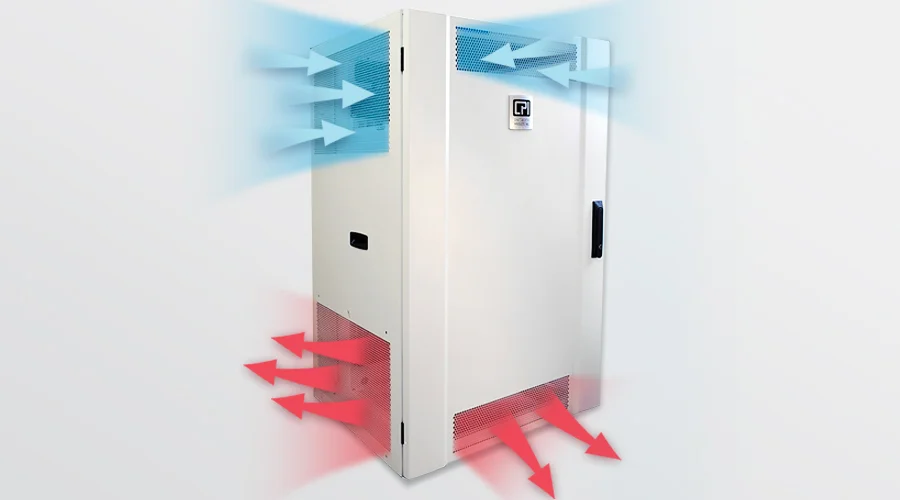
VersaEdge™ Wall-Mount Cabinet: Built for Advanced Airflow Management and More
Chatsworth Products (CPI) designs IT infrastructure that works with the environment, not against it. is engineered specifically for real-world edge conditions—where space is limited, cooling options are constrained, and reliability is non-negotiable.
VersaEdge supports improved thermal performance and operational efficiency through:
- Modular, scalable design that adapts to varied edge deployments and evolving hardware configurations
- Advanced thermal management with enhanced airflow geometry supporting passive heat dissipation up to 10 kW, plus optional modular cooling kits for higher-density demands
- Rapid deployment and simplified maintenance enabled by removable components and installation-friendly features
- Enterprise-grade security with combination and electronic locking options for controlled, audit-ready access
- Integrated cable management that maintains organized layouts without obstructing airflow
for your edge deployments.